Remove image backgrounds
Remove image backgrounds with local AI in Yagua. Check supported formats and initial model downloads; results depend on the image.
Reference edition 2.0.0. Version 2.0.0 is a pre-release for Windows and Linux, available by manual download. Some screenshots come from an earlier development edition and may show different controls; their values are examples. Review your package’s release notes and saving options before processing.
On this page
Before you start
This tool is optimized for products and light backgrounds. Results depend on contrast, edges, reflections, and scene complexity. Perfect hair, glass, or same-colored background separation is not guaranteed.
Select up to 10 images with the general selector. Use static, single-page files the package can read. There are no manual outline or brush-retouching controls.
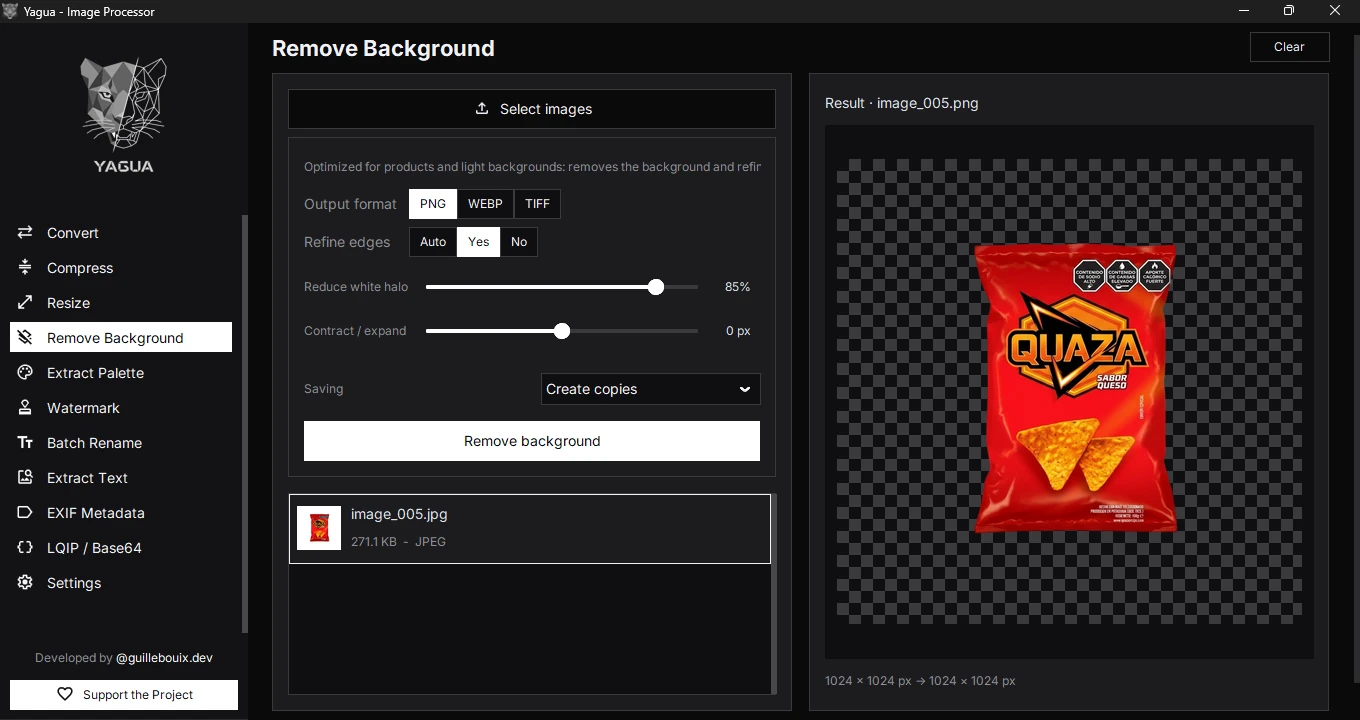
Controls and automatic behavior
| Control | Initial value or options |
|---|---|
| Select images | Loads or replaces the batch. |
| Output format | PNG; also WEBP and TIFF. |
| Refine edges | Auto, Yes, or No; initially Auto. |
| Reduce white halo | 0–100%, initially 85%. Works independently of refinement and reduces light contamination around semi-transparent edges when a uniform light background is detected. |
| Contract / expand | −5 to +5 px, initially 0 px. Negative values contract the mask; positive values expand it. Measured in original-image pixels. |
| Saving | Create copies or Overwrite originals. |
| Remove background | Prepares output and asks for confirmation. |
| Clear | Empties inputs without deleting models or saved results. |
There is no model selector or manual threshold. Auto cleans the mask and refines translucent edges when uniform light backgrounds are detected; Yes requests both operations for any background; No disables both. Halo reduction works independently and only applies when a uniform light background is detected. Contraction can remove fine detail; expansion can reveal background. The screenshot shows WEBP, refinement set to Yes, halo reduction at 85%, and a 0 px edge adjustment. The preview checkerboard indicates transparency; it is not part of the saved image. A final message may indicate fallback model use.
First run and connection
Missing models download when processing starts. Downloads and initial model setup can take substantially longer than later operations. The tested package uses CPU and does not require a dedicated GPU.
Wait through loading and analysis instead of clicking repeatedly. Available models can be reused offline.
Step by step
- Open Remove Background and load a clear photograph.
- Choose PNG for a first transparency test; WEBP and TIFF are also available.
- Review the refinement and mask edge. Set Saving to Create copies to preserve the input, click Remove background, choose a folder, and review the confirmation.
- Wait for any download, initialization, and processing.
- Before processing, the panel shows the original. Wait for the summary and select the row to see the saved result; then open the exported file in a viewer that displays transparency.
The view changes from Original before processing to Result after a successful save. It shows the exported file and its dimensions; it is not an unsaved-result preview. After changing controls, the saved result remains visible and you must process again to apply them. Some viewers show alpha over white or black; their background does not prove the output is opaque.
Example and saving
With PNG and Create copies, producto.jpg becomes producto.png in your chosen folder, or a numbered variant when occupied. This mode preserves the original. Overwrite originals allows replacement when formats match; changing format creates another file beside the original. Review the saving summary. All three output formats support alpha; JPEG is absent because it does not preserve transparency.
To add a logo afterwards, load the exported file in Watermark. Converting it to JPEG first loses transparency.
If something goes wrong
- Missing dependency: check the package and reinstall an appropriate version. Help-panel commands target source environments; running them in another Python does not repair a packaged executable.
- Download failure: check internet access and write permissions for the model cache.
- Incomplete cutout or visible halo: try the refinement and halo controls; you can also adjust the mask edge.
- Partial failure: inspect saved outputs before repeating the batch.
New selections replace old ones. Clear empties the screen without clearing AI caches or undoing saved results; the output format may remain selected.